BZ
Point BlankBZ is the drug that turns the apparent nightmare in Winkel’s Cave into a forensic clue: testing finds it in both Ruth Warnecki and Erin Bushnell, with more in Erin than in Ruth. The compound’s reported effects—confusion, hallucinations, impaired coordination, fear, and eventual stupor—offer an explanation for Ruth’s altered perceptions and help investigators infer that Erin was incapacitated before she was killed.
Identification and reported properties
The medical examiner first identifies BZ in Erin’s system after examining her body. He thinks the drug may have incapacitated her; the later discussion establishes that it was also present in Ruth’s blood sample. The substance is formally called quinuclidinyl benzilate, commonly shortened to BZ.
Dix Noble tells the others that he has looked up information about the compound. According to what he reports, BZ is a colorless, odorless gas, usually delivered as an aerosol, developed for military use in the 1960s. It acts fairly quickly and can increase heart rate, blur vision, and disrupt coordination. It is also described as a psychochemical: it can alter perception and thought, producing hallucinations, confusion, forgetfulness, and, eventually, stupor. The effects are unpredictable. Dix says exposure can cause overwhelming fear and panic or, at the other extreme, rage and attacks made without regard for personal safety.
His account places BZ in a history of attempted military and security uses rather than presenting it as a reliable weapon. He says it proved of limited use in war because reactions varied. He also mentions a similar agent reportedly used by Russian forces against Afghan guerrillas in the 1980s, and the possibility that gas was pumped into a Moscow theater during a hostage crisis, where high concentrations may have contributed to hundreds of deaths. These claims reach the group through Dix’s research; they do not identify the source of the BZ used in the cave.
Ruth’s exposure in the hidden chamber
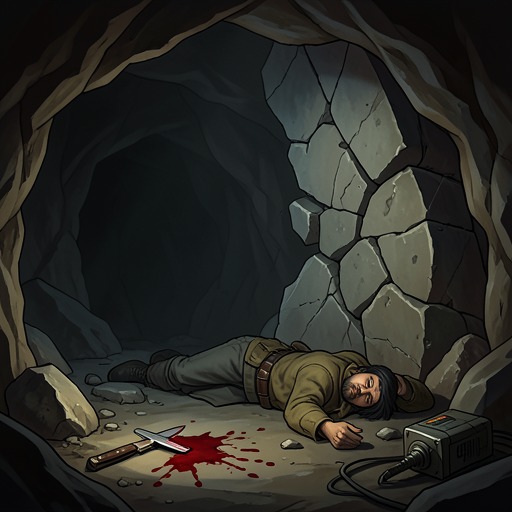
Before anyone identifies the drug, Ruth’s experience in the cave includes clues that, in retrospect, fit the later explanation. In the chamber she enters while following the treasure map, she notices that the air is fresher than the main passage, despite expecting a sealed space. She also registers an unidentified sweet scent. Soon she feels disoriented and heavy in her arms and legs; the sensation briefly seems to pass, then returns as she crawls onward.
Her sense of distance and direction becomes unreliable. She struggles to read the map and understand how far she has travelled. Although she believes she should be moving toward the eastern wall, her compass points west; shaking it does not change the reading. She feeds out the full twenty-five feet of her measuring tape and still finds no wall. With the chamber’s boundaries absent from her view and her own tools apparently contradicting her expectations, fear takes hold. Later, back in the cave, Ruth recalls a faint smell of jasmine from Friday, the day she entered. This memory gives investigators another detail to consider, but the evidence does not establish that jasmine is the odor of BZ; Dix describes BZ as odorless.
Forensic reconstruction
Once the test results are known, Ruth learns that her blood contained the same drug found in Erin’s, though in a lower amount. Sherlock notes that Erin was still alive when she was stabbed. The distinction matters: the evidence supports the conclusion that BZ incapacitated Erin, not that it had already killed her. Dix says the medical examiner found more BZ in Erin than in Ruth, and the group relates that difference to the cave accounts: Ruth describes terrifying confusion, while Erin may have experienced an even more severe exposure.
Savich proposes a possible sequence rather than claiming certainty. The killer may have used BZ on Erin, returned later to check on her, and encountered Ruth in the chamber, perhaps frightened or unconscious. He may then have struck Ruth or found her already injured and removed her from the cave. The investigators do not know which possibility is correct from the drug test alone. Savich’s explanation also distinguishes the intended roles of the two women: he calls the chamber Erin’s tomb, not Ruth’s, suggesting that Ruth’s survival and presence there were not part of the killer’s original plan.
Access, limits, and narrative significance
When Ruth asks how someone could obtain the gas, Dix says the medical examiner believes chemicals like BZ are available through pharmaceutical companies and online for legitimate research. He cautions that this makes it unlikely the compound will lead them to a neat, identifiable local supplier. Its presence is therefore powerful evidence about what happened in the cave, but not, by itself, proof of who administered it or where it came from.
BZ also changes the meaning of Ruth’s earlier recollections. Her impossible-feeling chamber, faulty sense of direction, impaired concentration, and mounting fear had appeared to be a psychological collapse in an extraordinary setting. The toxicology result supplies a physical cause for at least part of that experience, while leaving the precise sequence of the attack unresolved. The same evidence links Ruth’s ordeal to Erin’s murder without making their exposures identical: Erin had the higher concentration, and the investigation treats her incapacitation and Ruth’s confusing cave experience as related but distinct consequences of the drug.